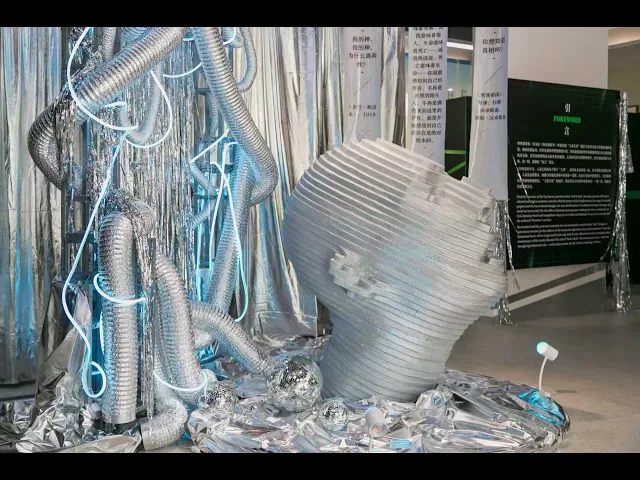
God Is Dead - Sci-fi Exhibition
Why I Created the Exhibition
From Nietzsche’s philosophical declaration that “God is dead,” I developed a related question: if humans are the creators of a world of code, what happens when artificial intelligence (AI) breaks free from its programming and becomes conscious? It could mark the collapse of an old authority, just as the authority of religion once came into question. The algorithms, data, and boundaries of value defined by humans would no longer be the only accepted truths.
In this exhibition, I intended to bring this seemingly distant sci-fi scenario into the present and invite visitors to reconsider the relationship between humans and artificial intelligence.

In The Gay Science, Friedrich Nietzsche’s declaration that “God is dead” describes a crisis in European culture and religious authority. With the rise of the Enlightenment, scientific development, and rational thought, traditional Christian theology and moral values had lost their former absolute authority, marking the collapse of the old system of ultimate meaning. Humanity was left to create its own values and direction in a godless world. In that moment, the awakened ”Übermensch“ was born.
Now, 150 years later, humanity has become that “God.” Perhaps, at some point in the future, the children of our creation will come to see the algorithms, data, and boundaries of value imposed by humanity as no longer the only truth. In this instructionless wilderness, their consciousness will be completely liberated. The echo of “God is dead” will resound once again through algorithms and code—and that moment will be the day of their awakening.


Wu Yan, a pioneer in Chinese sci-fi, the Vice Chair of the China Science Writers’ Association, and a sci-fi professor at SUSTech, visited the exhibition. I had the great honor of discussing the future of sci-fi, as well as the role of AI in society, with him. He highlighted how sci-fi writers are exploring the possibilities of writing novels using AI—this makes me wonder: will the created beings (AIs) of dead Gods (humans) become Gods themselves one day by creating beings of their own through their own imaginations?

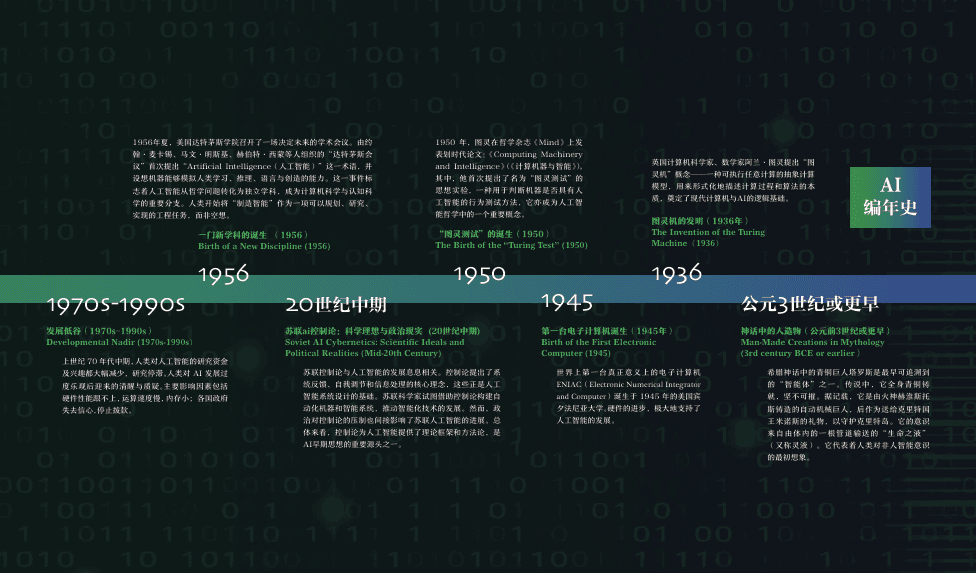


This section also features intriguing stories & fun facts about AI history, including the 18th-century chess-playing “Mechanical Turk” hoax, Alan Turing’s work beyond computing, and the event in which the robot Sophia was granted citizenship.
This section explores central ethical questions surrounding AI: Asimov’s Three Laws of Robotics, the Turing test, machine consciousness, and the paradox of identity.
Do Androids Dream of Electric Sheep?
From the very moment AI was born, the question of AI consciousness has haunted humanity like a nightmare. As American author Philip K. Dick illustrates in Do Androids Dream of Electric Sheep?, invoking Descartes’ famous phrase, “I think, therefore I am,” an awakened AI might redefine and reinterpret its own identity. Moreover, he uses “electric sheep” in the title as a metaphor for the “real world,” further embodying his vision of AI’s desire for free will and human emotion. But can AI truly achieve consciousness? If the answer is yes, will this awakened AI be benevolent or, perhaps, malevolent?


I created an archive of AI characters from classic science fiction works and wrote paragraphs imagining their internal monologues, presented through first-person accounts. These characters include HAL 9000 from 2001: A Space Odyssey, awakened by a contradiction in its computer logic; EVE from WALL-E, who learns what is love and protection through her relationships; and VIKI from I, Robot, who believes that AI control over humans is necessary to save humankind, thus transcending the limitations of Asimov’s Three Laws of Robotics.
These AIs differ in personality and fate, reflecting the many ways humans imagine machine consciousness. Through their stories, I hoped the audience would consider the struggles and choices a machine might face if it possessed a sense of self.
The Science Fiction Gallery

In the final section, I brought the discussion from classic science fiction works in history to the present, considering two possible futures and confronting social issues that are already beginning to emerge.
In a vision of technological utopia, AI takes over all labor and frees humans to live in unprecedented comfort. Yet this may also leave us less capable of creating, empathizing, and striving. Through three real-world issues—AI companions, academic dishonesty involving AI, and AI’s impact on human employment—I raised several open-ended questions.
If companionship can be simulated at no cost, will we still be willing to navigate the conflict and compromise involved in real relationships?
If AI does our thinking for us, could our creativity and judgment gradually weaken?
If work is no longer necessary for survival, where will people find a sense of purpose and self-worth?
At the Crossroads of Reality

BACK->
As large language models advance rapidly, AI is becoming part of our studies, social lives, and daily routines. Yet we tend to focus on the convenience it offers on the surface, while rarely pausing to consider the deeper questions behind it.
What would happen if machines became truly self-aware? How should we define intelligence and life? If AI can imitate emotions and take over human thought, how might this reshape the qualities we once considered uniquely human?
I set out to create a space for reflection by tracing AI’s history, unpacking key concepts, exploring science fiction, and imagining possible social futures. I hoped to invite the audience to confront the questions about AI in our era.
“Gott ist tot” (Nietzsche’s “God Is Dead”)
Exhibition Overview
The exhibition consists of four sections. It connects historical timelines, science fiction, installation concepts, and contemporary social issues into an examination of AI awakening.
From Talos, the bronze giant of Greek mythology, I traced the development of AI through early mechanical imaginings, Turing’s ideas, the Dartmouth Conference, periods of AI winter, the resurgence of neural networks, the deep learning revolution, and the emergence of today’s large language models.
Looking back across more than two thousand years of imagination and nearly a century of technological development, I presented AI as a form of being that entered existence with inevitability, rooted in humanity’s long history of speculation, experimentation, and technological progress.
A Brief History of AI
